Who Gets to Study Abroad? Social Inequality and Educational Mobility in Taiwan

A webinar hosted by the Canadian Association for the Sociology of Education (CASE-ACSE) and the Canadian Sociological Association’s Sociology of Education Research Cluster (CSA/SoE).
January 14, 2027 @ 12:00pm Eastern Time
Moderators:
Dr. Erica Thomson and Dr. Alexandra Pulchny
Co-Chairs of the CSA Sociology of Education Research Cluster
Presenter: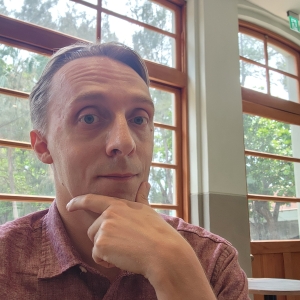
Eric D. de Roulet
PhD candidate, Interdisciplinary Graduate Studies
University of British Columbia (Okanagan campus)
Study co-author Hsuan Li 李諼
Who Gets to Study Abroad? Social Inequality and Educational Mobility in Taiwan
Taiwanese postsecondary students who aim to pursue further education abroad face a precarious geopolitical situation, increasingly securitized immigration regimes, and numerous other structural forces that cast doubt on their academic career prospects. This study (de Roulet & Li, forthcoming) uses Bourdieusian, geographical, and information science perspectives to investigate Taiwanese prospective international students’ self-efficacy (i.e., understanding and exercise of their agency) as they assess and their study-abroad pathways.
Through site visits to study-abroad expositions and university campuses as well as interviews with postsecondary students and their advisors, we find that these students have access to substantial cosmopolitan cultural capitals and social networks to support their study-abroad endeavors. But due in part to Taiwan’s history of lopsided economic development policies and circular migration between Taiwan and the U.S., and the class realignment that resulted from this, these resources are unevenly distributed across class, geography, and linguistic/ethnic background. More significantly, these class- and social network-based advantages structure students’ information environments, shape their information-seeking behaviours, and funnel them towards particular study-abroad options (while foreclosing on viable alternatives).
This study advances our understanding of advantage and equity for the Taiwanese context by profiling the country’s 21st century class structure and the distribution of higher education advancement opportunities across space and class. For East and Southeast Asia’s post-development societies more broadly (e.g. Japan, South Korea, China, Hong Kong, Singapore), this study demonstrates the socioeconomic pressures that contribute to students’ experiences of precarity and highlights the prominence of study-abroad consultancies in these countries’ higher education industries.
Key words:
Social networks, cultural capital, ISM (international student mobility), development policy, social class, information brokers, information environment, higher education industry